
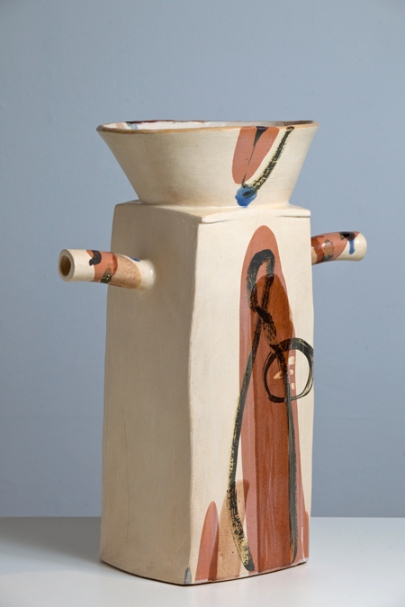
Alison Britton

.

Alison Britton, ‘Influx’ (2012)

photo © Philip Sayer courtesy of Marsden Woo Gallery

.

Alison Britton, ‘Tall Scrawl’ (2009) ceramic

photo © Philip Sayer courtesy of Marsden Woo Gallery

.

Alison Britton, ‘Cave’ (2012)

photo © Philip Sayer courtesy of Marsden Woo Gallery

.

Alison Britton, ‘Runnell’ (2012)

photo © Philip Sayer courtesy of Marsden Woo Gallery

.
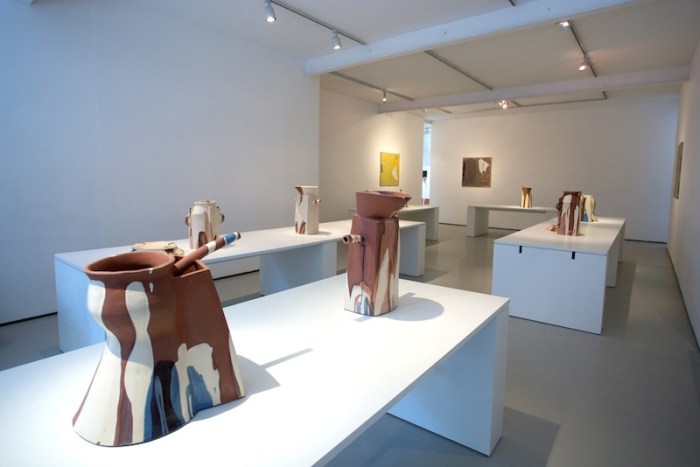
Alison Britton, ‘Standing and Running’, installation shot 2012

© Philip Sayer courtesy of Marsden Woo Gallery

.

Alison Britton is part of the generation of innovative British ceramicists that emerged during the 1970s, whose work laid the foundations for what became known as ‘The New Ceramics’. She studied at the Central School of Art and Design and the Royal College of Art, and is highly regarded as a writer, curator and lecturer, as well as a ceramicist. Her work has been exhibited internationally, and can be seen in major public and private collections worldwide,including the V&A, London, Royal Museum of Scotland, Edinburgh, Australian National Gallery, Canberra, National Museum of Modern Art, Kyoto, and Musée des Arts Décoratifs, Paris. She was awarded an OBE in 1990 for her services to the applied arts, and is a senior tutor at the RCA.

Confidently standing as part sculpture, part painting, part domestic vessel, this work states its presence in a firm tone in Alison’s most recent show, “Standing and Running”, at The Marsden Woo Gallery in London.

Alison works in an interesting way, by rolling out the clay and working on it as if it were a painting, applying various slip colours and designs, before using that design to suggest a final form. To me this helps to lend an unrestrained energy  - they are freed from the wheel. There’s an almost jazz-like sense of an improvised, “lets see what happens” spirit, within the framework of something structured and considered, and slightly hard to get inside of.

On reading some of the many words that have been written about Alison Britton’s work, the constantly returning theme is the vain attempt to be able to classify it. This is perhaps the mark of a true original, authoritatively embracing both art and craft, function and form, the abstract and the actual.

The Frank Lloyd Gallery leaves its final words on Alison’s work to Quentin Blake, who says, “the work may begin as a jug, but it becomes a free-standing story, a poem, a situation. Put in the position of reader, the viewer comes back again and again, each time finding a new word, line, or verse to fall in love with.”

Perfect.

There are some interesting discussions on a piece of Alison’s work in the V&A video archives, here

Find out about new exhibitions and other artists represented at the Marsden Woo Gallery site here.

.

Jeff Soan – Wooden Creatures

I received something really unusual through the post this week!

.

 .

I couldn’t make it to see wood sculptor Jeff Soan’s latest exhibitions, and so he very kindly sent me this little fish, to give me more of an idea of how his work moves in the flesh. As he said, it is “part of the pleasure”.

I know that I am always getting very excitable about the work that I feature here – that’s not only because I only choose to write about things that do genuinely interest me, but also because these really are, in my opinion, something very special.

Made from ash, this little fish sits lightly in my palm, and with each movement of my hand, it bends and moves as if it is alive. Each little cut into the wood is so precise, the design so perfect and true. The finish is truly lovely, a mix of scarred and darkened wood, bright shimmering greens and polished amber hues.

Jeff says that he prefers to use spray paint to decorate these fish – applied through, of all things, fishnet tights – a happy discovery one day when looking for a perfect way to mimic the texture of fish scales.

He follows the arrangement of the annual rings in the wood, finding beautiful curves and circles which form part of the design.

“I go with the wood, I want to enhance what it is saying already”

Patterns and natural forms are then brought to life by tried and tested combinations of torching, digging in, spraying and sanding, until the desired effects are reached. Torching the wood not only gives a beautiful dark sheen, but lends the piece an extra special sensory value, as it smells so beautifully of wood smoke! Jeff also says that as the wood is torched, it naturally forms into scales, the pattern deepens in.

This little fish sparkles like real scales do, in the light.

.

.

By cutting the wood into narrow sections, and securing it to canvas, Jeff enables the most amazing movement into his creatures.

These beautiful seals, one of his most popular creations, will curl and move to your touch, gazing up at you in such a soft eyed, lifelike way that it’s almost unnerving!

.

.

I have to smile a little that this Border Terrier is made of Douglas Fir. Jeff has made crocodiles from this wood too, as he likes the “reptilian texture”. Hammered, scraped and gouged, it certainly gives a pleasingly furry impression to this little dog, with a really “muzzley” muzzle. (Yes I made up that word.)

.

.

“I love O-Matic’s!”, says Jeff, describing this dear little automata. It puts me in mind of some of the inventions finding their way out of Wallace and Gromit’s workshop. He cites Heath Robinson, ”..although my mechanisms are rather the opposite of complex.”

As you move the handle, the dog moves and wiggles, wagging its tail. It was, as Jeff describes, “a bit of a disaster really.. I am rubbish at automata”. But I think that its clunky nature and slight aura of embarrassment is totally part of the charm.

.

.

Jeff prefers to work with reclaimed wood. He tries to use every part of it, so that for example, he says “the offcut portion of a fishes tail may form the breast of a bird.”  He says that he particularly enjoys working with partially rotted wood, which, once microwaved and cleaned to stop the rot and remove any hidden residents, gives way to wonderful naturally formed raised areas, textures, and colours.

He rarely uses traditional tools, preferring to make use of many usual and unusual implements in his self titled pursuit of “wood butchery”. Rotary carving tools, blowtorches, wire brushes and even meat tenderisers are some of his preferred items to hand.

“I’ve got used to power” he says, talking of his tools, and, with a certain mix of both guilt and pride, “I abuse wood horribly”.

.

.

It takes a real talent to be able to embue a sense of individual character and expression into every object – that skill is certainly in abundance here. I love the rough yet tender qualities of this stocky Bull Terrier, complete with scarred face and limbs. Jeff claims that he “is not an artist”, but I don’t think that you could create this kind of work if you did not have an artists eye. This is not just “putting things together”. There is real love here.

.

.

Recently, Jeff was given some of the original timber from the Cutty Sark, and asked to make creatures that would have been found on and around the ship.

The lovely Collie above is made from oak, and the collar made from the original hull planking. He is modelled on the dog kept by the aptly named Captain Woodget, who sailed the Cutty Sark during her most successful period of service in 1885. Captain Woodget sounds like a fascinating character, who Jeff tells me was known for his habit of roller skating on deck!

The powdery, matt black finish is achieved by painting with an iron solution, which creates a really natural looking colour that is actually created in the fibres of the wood, rather than sitting on top. This is painted or sprayed in. I love the effect.

This, other animals, and even a small automata of the ship, made from offcuts from a mixture of timbers, will be on display at the re-launch.

I asked him what inspires him to continue to work in wood in this way. He answered, “I don’t really know why I keep doing this..sometimes I just think, what’s the point, so what?” But then he tumbles into an excited run of sentences about this experiment and that, new techniques he has learned, new things that fascinate him, and it is obvious that this is still a love to him, these are not just run of the mill offerings..I think this is immediately evident in the objects themselves, which fizz with energy and life – this is true passion, and true, grown skill, from a real craftsman.

You can find Jeff’s website and blog here.

.

Holly Berry – Woven Code

I was really taken by these little squares of woven morse code when I first came across them. As a child I remember being fascinated by this secret language. Weaver Holly Berry has managed to capture some of this quiet mystery, and woven it into something very lovely indeed. Different on each side of the cloth, her blankets and scarves hide secret messages, stories and memories, that can be passed down for generations.

Holly’s larger blankets are woven in a 250 year old mill in Scotland and spell the word ‘LOVE’ throughout them in Morse-code. Her scarves and wraps are woven by hand in her South London studio. Holly can also make something to a bespoke design – tell her the message or story that you want to be hidden in the blanket, and she will make it for you.

I think this is such a fascinating idea – I love the thought of creating something which contains maybe an important family story, or a private message of love, to be kept and remembered.

.

.

This mix of art and function makes these blankets really special I feel. There is a celebration of craft and traditional practice, but which also encompasses the new world, and our love for storytelling and a sense of value.

.

.

“My luxury woven cloths, accessories and blankets are to be used everywhere and anywhere, inside and out, providing the warmth of wrapping yourself up in a protective and decorative layer, and enriching your experience with colour, warmth and love. I wish to create heirlooms that capture memories and stories and encourage an emotive connection between textile and owner.

.

I’m always fascinated by where people get their inspiration – Holly seems to find it all over the place – the inspirations gallery on her blog shows a wide variety of sources and starting points, from chalk drawn pavements to note book sketches and piles of old fish crates – colours of skies, slates, and powdery sweets..acidic yellows and oranges adding an edge..there’s a sense of both the urban and the natural world, woven into one..and still that great feeling that always inspires me, of something that has taken time, thought, and a human hand to create.

.

.

.

.

.

You can read more about Holly and her work on her website and blog -

www.hollyberryprojects.com.

.

ο                    ο                    ο                    ο                    ο