
• Joseph Cornell

    .

    Assemblage boxes by American artist, collagist, and filmmaker Joseph Cornell.

    .

    Tilly Losch
    c. 1935

     Construction, 10 x 9 1/4 x 2 1/8 in; Collection Mr. and Mrs. E. A. Bergman, Chicago

    .

    Object (Roses des Vents)
    1942-53

     Construction, 2 5/8 x 21 1/4 x 10 3/8 in; The Museum of Modern Art, New York

    .

    Untitled (The Hotel Eden)
    c. 1945

     Construction, 15 1/8 x 15 3/4 x 4 3/4 in; National Gallery of Canada, Ottawa

    .
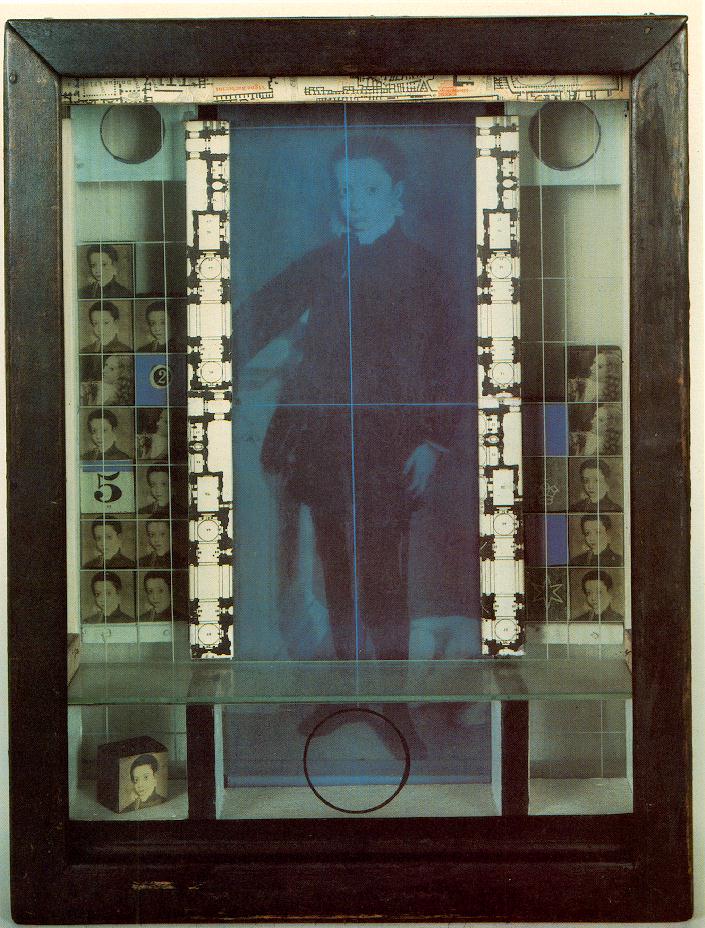
    Untitled (Medici Prince)
    c. 1952

    Construction, 15 1/2 x 11 1/2 x 5 in; Collection Mr. and Mrs. Joseph Shapiro, Oak Park, IL

    .

    Toward the Blue Peninsula
    1951-52

    Construction, 10 5/8 x 14 15/16 x 3 15/16 in; Collection Daniel Varenne, Geneva

    .

    I find Joseph Cornell such an intriguing character.  Self taught, he was one of the pioneers and most celebrated exponents of assemblage. I am in love with his sense of symmetry, both in design and colour. There is something very calming about the exactness of these boxes. Everything just fits, it works. Each square is where it is born to be, each shape leads you to the next, creating a great journey for the eye to dream upon. There are stories and surprises in every box, offering small places of contemplation and inspiration that celebrate the unique in the commonplace.

    I have always been fascinated by miniature worlds, looking into something and finding a million other little scenes and universes. These give me that feeling, like gazing into a deep rockpool and imagining yourself grown tiny and swimming inside. You cannot help but try to formulate connections between the objects here, to uncover meaning and create stories.

    Cornell was a passionate collector – books, prints, postcards, and printed and three-dimensional ephemera all found their way into his life and work. He was also continually keeping notes and diaries, exploring ideas and carrying out “explorations” where he would conduct research, collect material and compile extensive files on individuals or topics of interest to him. These became thought of as artworks in themselves.

    There is a fascinating collection of his papers, correspondance and diaries, along with a biography, at the Archives of American Art website here. See some more of his works here.

     .

  • Illustrated Life

    .

    .

    For something a bit different this week, I thought I would share with you some fascinating illustrations that I came across a few weeks ago.

    I found “The Complete Encyclopedia of Illustration” by J.G. Heck, in a local cafe – they have a whole wall of books to dive into there and this one caught my eye.

    First published in 1851, as “The Iconographic Encyclopedia of Science, Literature and Art”, the work was based on one of the finest encyclopedias of its day, the “Bilderatlas” by Friedrich Arnold Brockhaus. It contains over 12,000 black and white engravings, illustrating just about everything a Victorian reader could have possibly imagined. It is separated into ten major sections – Mathematics and Astronomy, Natural Sciences, Geography and Planography, History and Ethnology, Military and Naval Sciences, Naval Sciences, Architecture, Mythology and Religious Rites, Fine Arts, and Technology.

    Each single item is painstakingly captured – some fall into dreamlike representations of clouds, birds, and creatures, some show the fascinations and inventions of scientific fervour, and the quest for discovery. As well as finding each illustration totally fascinating, I love the language used to describe each one – the beautiful Latin names that roll off your tongue, and the intriguing descriptions which transport you back to a time of mysterious, yet to be discovered worlds.

    As well as providing me with a great moment of tea and inspiration, this book has reminded me to always keep looking and noticing – in times where we feel that all is discovered, it is warming and uplifting to be reminded of the curious beauties, oddities and fascinations in the world, and the depth of human endeavour it has taken, and still takes, to discover and record them.

    I hope you enjoy my selections! Click the images to see larger representations.

    .

    Plate 26: Phenomena of clouds and light.

    1-9. Phenomena in clouds

    10-12. Rainbows

    13. Aurora borealis

    14. Midnight sun in the polar regions

    .

    Plate 16: Theories of force and gravity; demonstrations of these and other physical laws

    Including:

    4. Parallelopipedon (yep) of forces

    14. Illustrating Varignon’s funicular machine

    17, 18. Atwood’s machine for demonstrating the freely falling of bodies

    .

    Plate 92: Members of the orders Anseriformes, Pelecaniformes, Charadiiformes, and Sphenisciformes

    Including:

    1. Carbo cormoranus, cormorant

    7. Anser segetum, bean goose

    10. Merges cucullatus, hooded merganser

    .

    Plate 228: Gymnasium and acrobatics

    Upper division

    1-12. The German gymnasium

    Lower division

    1-8. Acrobatic feats

    .